Huedle Scoring Explained: 1,000-Point System & Par Swaps
Discover why fewer swaps beat fast clicks by roughly 6-to-1, how mathematical Par works via cycle decomposition, and what it takes to break 950/1,000.
Huedle scores up to 1,000 points with swap count carrying the dominant share and speed acting as a secondary bonus. Exact minimum swaps (Par) equals movable tiles minus permutation cycles—typically 15–19 swaps on a 5×5 grid.
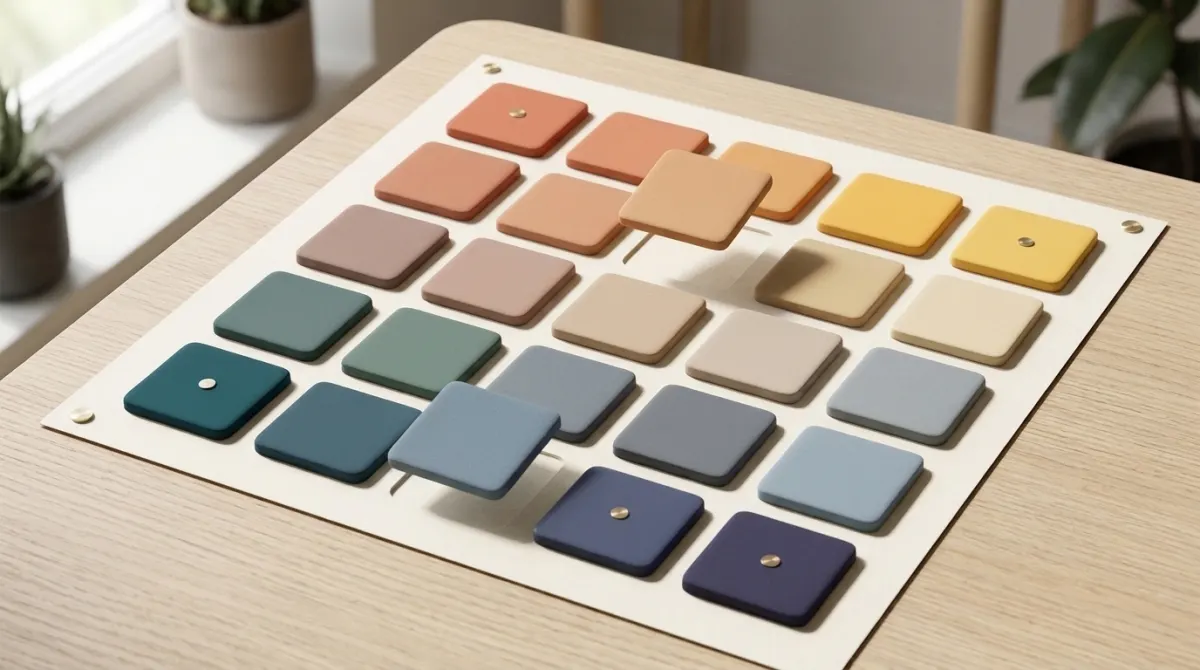
How Huedle Scores Every Board Out of 1,000
One of Huedle's smartest design choices is that every board ends in a win—there are no strikes, hearts, or failed streaks. Instead, competition revolves around a 0 to 1,000 point scale driven by two factors in strict priority order:
- Swap efficiency (Primary weight): How close your total number of tile swaps stays to the board's optimal swap count.
- Completion time (Secondary bonus): How briskly you solve once you make your first move.
Because swap efficiency outweighs raw speed, a calm 45-second solve in 17 swaps consistently beats a frantic 22-second solve in 24 swaps.
What Is Mathematical "Par" (Minimum Swaps)?
Every shuffled Huedle grid is a permutation of its movable tiles (for a standard 5×5 grid, 25 total tiles minus 4 locked corners equals 21 movable tiles). Even if a board looks chaotic, there is always an exact mathematical minimum number of swaps required to restore it—known in combinatorics as cycle decomposition:
Minimum Swaps (Par) = Total Movable Tiles − Number of Disjoint Cycles
Here is a concrete mini-example to make that intuitive:
- Fixed tile (1-cycle): A tile that already starts in its solved slot forms a cycle of length 1 and needs
1 − 1 = 0swaps. - Swapped pair (2-cycle): Two tiles sitting in each other's spots form a cycle of length 2 and need
2 − 1 = 1swap to fix both at once. - 4-tile loop (4-cycle): Tile A is in B's spot, B is in C's, C is in D's, and D is in A's. That 4-tile loop takes exactly
4 − 1 = 3swaps—and every single swap places one tile permanently, with the final swap placing two tiles at once.
On a typical randomly scrambled 5×5 board (21 movable tiles), the shuffle usually breaks into 2 to 5 cycles, placing theoretical Par between 16 and 19 swaps. A flawless player who never makes an unproductive swap can literally solve the entire 21-tile grid in 17 clicks!
Practice Studio 1,000-Point Breakdown
To help you measure real progress between official daily games, our Huedle Unlimited Practice Board displays your live Par and breaks the 1,000-point score transparently:
| Component | Max Points | How It Scales |
|---|---|---|
| Swap Efficiency | 820 pts | Full 820 pts when Moves ≤ Par; decays smoothly as (Par / Moves)^1.35 for every extra swap |
| Speed Bonus | 180 pts | Full 180 pts inside the grid's brisk target time; gently tapers exponentially as elapsed time grows |
| Hint Penalty | −35 pts each | Each Hint highlights one exact 1 → 2 swap pair and deducts 35 points from the final score |
Notice how heavily this mirrors the real Huedle trade-off:
- 1 extra swap above Par on a 17-Par board costs roughly 60+ swap points.
- 5 extra seconds of careful checking costs only ~5–10 speed points.
That 6-to-1 ratio proves mathematically why pausing to double-check a subtle colour pair before clicking is the fastest route into the 900+ tier.
Benchmark Score Tiers for Daily 5×5 Boards
| Score Range | Typical Swap Margin | Skill Tier |
|---|---|---|
| 960 – 1,000 | At Par or +1 swap, clean pace | Studio Master — near-zero wasted moves |
| 880 – 959 | +1 to +3 swaps over Par | Sharp Colorist — strong perimeter & cycle flow |
| 750 – 879 | +4 to +7 swaps over Par | Solid Daily Solver — occasional midtone re-swaps |
| Under 750 | +8 or more extra swaps | Warm-up Tier — practice 4×4 Par drills first |
How to Push Your Average Above 920
Two quick adjustments produce the biggest jump on your scorecard. First, practise on 4×4 Warm-up mode until you can hit Moves = Par three boards in a row—this builds muscle memory for direct cycle chaining. Second, check our Colour Vision & Display Tips to eliminate Night Shift or True Tone warm tints that cause avoidable last-second swap mistakes.
Frequently Asked Questions
Does speed or fewer moves matter more in Huedle?
Swap efficiency (fewer moves) is weighted much more heavily than raw speed. Avoiding even two unnecessary swaps preserves far more points than shaving ten seconds off your clock.
What does Par mean on the Huedle Wiki practice board?
Par is the exact mathematical minimum number of swaps needed to solve a shuffled grid, computed via permutation cycle decomposition (movable tiles minus disjoint cycles). On a standard 5×5 board, Par typically falls between 15 and 19 swaps.
Is a perfect 1,000 score actually possible?
Yes. Finishing at or under Par within the target pace without using hints awards the full 1,000 points on the practice board.