Huedle Unlimited & Colour Gradient Wiki
Play unlimited OKLab colour gradient boards (4×4 to 7×7) with 1,000-point Par scoring, daily leaderboard, and strategy guides.
1000 / 1,000
What Is Huedle & Why Four Locked Corners Change Everything
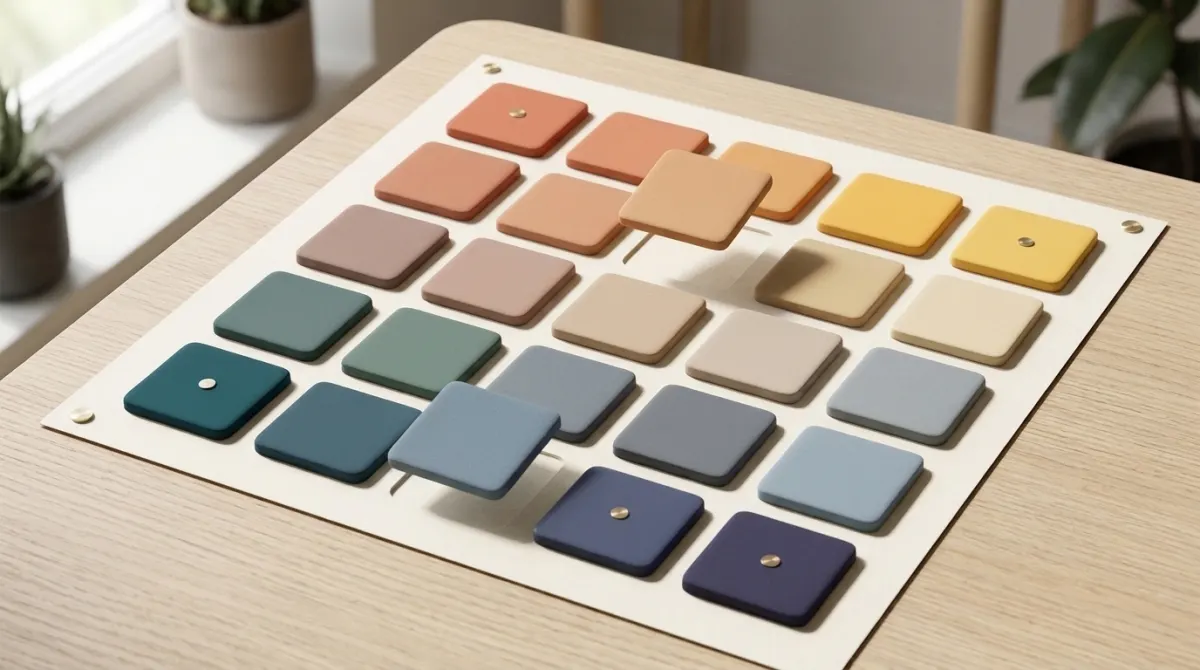
Huedle is a minimalist daily visual puzzle that turns colour perception into a crisp logic challenge. Each board presents a scrambled grid of tinted swatches whose four corners stay permanently pinned in place. Your goal is to swap the remaining tiles until every row and column flows seamlessly from corner to corner.
Unlike timed arcade games, there is no game-over state in Huedle. Instead, mastery is measured out of 1,000 points where swap economy outweighs raw click speed. Our independent practice studio recreates that loop with perceptually smooth OKLab palettes, instant Par calculation, and unlimited 4×4 to 7×7 boards.
How to Solve Any Huedle Board in Fewer Swaps
-
01
Inspect the Four Locked Corners
Read the four pinned corner tiles first to see which axis shifts warm-to-cool and which shifts light-to-dark.
-
02
Build the Outer Perimeter Frame
Locate the highest-saturation or brightest edge swatches and swap them straight onto the top, bottom, left, and right borders.
-
03
Use Direct Cycle Swaps
Never nudge a tile one square at a time—swap any misplaced tile directly into its exact final coordinate to resolve two slots efficiently.
-
04
Verify Midtones & Finish Strong
Flip between Paper Mat and Dark Mat whenever central neutral tiles blend together, then finish the centre cross cleanly.
Why Unlimited Huedle Practice Sharpens Your Daily Score
In the official daily Huedle puzzle at huedle.uk, every player shares one fresh colour gradient board each day. Because there is no way to lose a board, mastery comes down to two skills: spotting subtle hue and lightness transitions across a 2D field, and planning tile swaps that fix two misplaced positions at once rather than sliding tiles step by step.
Practising across multiple grid sizes builds both instincts rapidly. Starting on a 4×4 warm-up grid lets you internalise how four locked corners pull lightness horizontally and chroma vertically. Stepping up to 5×5 Classic, 6×6 Hard, and 7×7 Master boards trains your eye to distinguish near-identical desaturated midtones in the centre of the grid—the exact area where most players burn extra swaps on the official daily board.
Understanding the 1,000-Point Score & Mathematical Par
Every freshly shuffled board on this practice studio computes its exact minimum swap count (Par) using mathematical cycle decomposition. Any scrambled permutation of movable tiles breaks into disjoint cycles; a cycle of length k always requires exactly k − 1 swaps to resolve.
| Grid Mode | Total Tiles | Locked Corners | Movable Tiles | Typical Par Swaps | Best For |
|---|---|---|---|---|---|
| 4×4 Warm-up | 16 | 4 | 12 | 7 – 10 swaps | Learning corner anchors & swap cycles |
| 5×5 Classic / Daily | 25 | 4 | 21 | 15 – 19 swaps | Official-style daily training & leaderboard |
| 6×6 Hard | 36 | 4 | 32 | 25 – 29 swaps | Fine tonal differentiation in midtones |
| 7×7 Master | 49 | 4 | 45 | 37 – 42 swaps | High-precision studio colour calibration |
Just like the official Huedle scoring philosophy, fewer swaps carry the heaviest weight (up to 820 of the 1,000 points), while solve speed contributes the remaining 180 points. Spending three extra seconds to confirm a clean swap beats rushing into two corrective swaps every single time.
Built-In Tools for Accurate Colour Perception
Ambient room glare, warm screen filters, and bright white page backgrounds can skew how your eye judges subtle colour ramps—an effect colour theorists call simultaneous contrast. Use the Dark Mat toggle above the board to switch the tile surround between warm archival paper (#F6F1E9) and neutral studio dark (#18181B). When a middle row looks muddy on light paper, flipping to the dark mat immediately reveals hidden luminance steps.
If you play with a keyboard, the entire practice grid supports full 2D arrow-key spatial navigation with Enter or Space to select and swap tiles. Players with colour-vision deficiency—or anyone verifying a tricky 7×7 grid—can also toggle Coords to reveal row-and-column guide tags or press Hint to highlight one exact direct-swap pair.
Official Huedle vs. Huedle Wiki Practice Studio
Huedle Wiki is an independent, unofficial fan wiki and training companion. When you want to play the official daily colour gradient puzzle, track your official archive streak, or climb the global official leaderboard, visit huedle.uk. When you want unlimited boards, Par-swap diagnostics, keyboard practice, and strategy breakdowns between daily resets, keep this studio bookmarked.
Frequently Asked Questions About Huedle
What is Huedle?
Huedle is a free daily colour gradient puzzle game (originally launched at huedle.uk) where you swap scrambled colour tiles across a grid until all tiles form one smooth two-dimensional colour gradient anchored by four locked corner tiles.
Can I play Huedle Unlimited more than once a day?
Yes. Huedle Wiki provides a free browser-based Huedle Unlimited practice studio with a daily seeded 5×5 challenge plus endless randomly generated 4×4, 5×5, 6×6, and 7×7 OKLab colour gradient boards—no account or download required.
Why are the four corner tiles locked in Huedle?
The four corner tiles carry small pinned dots and cannot be moved. They define the exact starting and ending colours for the top, bottom, left, and right edges so every other tile has one mathematically unique home on the grid.
How does Huedle 1,000-point scoring work?
Every Huedle board scores up to 1,000 points. Swap efficiency counts most—minimising total swaps relative to the board's theoretical minimum (Par) drives the bulk of your score—while completion time acts as the secondary speed bonus.
What is the best strategy to get a high score in Huedle?
Solve the four outer perimeter edges first while using the locked corners as fixed references, then work inward by rows or diagonals. Always avoid sliding a tile one space at a time; swap a tile directly into its true destination so every move locks at least one tile permanently.
Is Huedle Wiki the official Huedle website?
No. Huedle Wiki is an independent, unofficial fan wiki and practice tool created for colour-puzzle enthusiasts. It is not affiliated with or endorsed by the official Huedle game at huedle.uk.
No notes yet — post your best swap count or gradient tip above.
Player Notes & Colour Tactics (0)
Share your best 5×5 swap count, palette tips, or favourite practice grid size.