How to Play Huedle: Rules, Locked Corners & Controls
Everything you need to know before your first Huedle board: locked corner anchors, direct tile swaps, 1,000-point scoring, and keyboard controls.
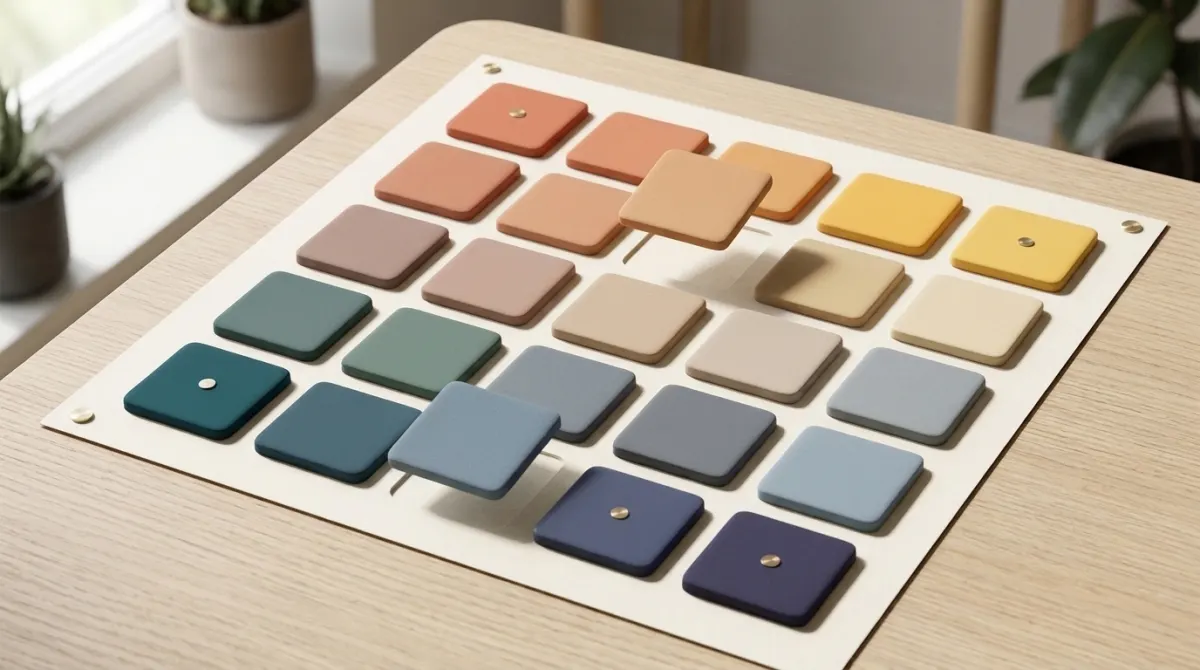
Huedle locks the 4 corner swatches as fixed anchors. Tap, drag, or arrow-select any two unlocked tiles anywhere on the board to swap them until the full 2D gradient flows cleanly. Fewer swaps earn the highest score out of 1,000.
The Core Rules of Huedle
Huedle strips colour-gradient puzzles down to four clean rules that take ten seconds to learn and weeks to master:
- One continuous 2D colour gradient: Every solved board smoothly blends four distinct corner pigments horizontally across every row and vertically down every column.
- Four locked corner anchors: The top-left, top-right, bottom-left, and bottom-right tiles display small anchor dots and cannot be swapped. They act as permanent coordinates so the board always has one exact solution.
- Unrestricted tile swaps: Tap or click any movable tile, then tap any second movable tile anywhere on the board to swap their positions. You do not have to swap adjacent tiles—jumping straight across the grid counts as a single move.
- No failure state, 1,000-point score: You can never run out of guesses or lose a streak by taking extra moves. Instead, every completed board receives a score out of 1,000, where keeping your total swap count low matters most and solve speed determines the remaining bonus.
Reading a Huedle Board Before Your First Move
Many newcomers begin tapping tiles the moment a board appears, which immediately starts the clock and creates unnecessary extra swaps. Take two to three seconds on your very first glance to map the two axes of the board:
- Horizontal axis (Left ↔ Right): Compare the top-left and top-right pinned corners, then compare the bottom-left and bottom-right corners. Usually one edge shifts sharply in hue (such as terracotta into warm saffron) while the opposite edge shifts across a cooler family (such as slate blue into seafoam teal).
- Vertical axis (Top ↕ Bottom): Compare top-left to bottom-left, and top-right to bottom-right. Notice whether lightness drops from top to bottom or rises diagonally.
Once your brain labels the four borders—for example, warm top, deep cool bottom, vivid right, muted left—locating where almost any tile belongs becomes instant rather than trial-and-error.
Daily Mode vs. Unlimited Practice Modes
On the official Huedle site, everyone receives the exact same daily colour palette once every 24 hours, along with access to past daily puzzles in the archive and a global leaderboard.
In the Huedle Wiki Unlimited Practice Board, you can train both ways:
- Daily 5×5 Seed: Uses today's date as a deterministic seed so everyone practising on Huedle Wiki gets the same palette and shuffle, complete with a daily Top-5 solver board.
- 4×4 Warm-up: Ideal for first-time players learning to read corner anchors without getting overwhelmed by subtle centre midtones.
- 5×5 Classic: Matches the classic 25-tile grid feel with 21 movable tiles.
- 6×6 Hard & 7×7 Master: Expands the board to 32 and 45 movable tiles, compressing colour differences between neighbouring swatches so your eye sharpens far faster than playing 5×5 alone.
Controls: Touch, Mouse, Drag, and Keyboard
You can play comfortably on both phone and desktop without changing habits:
- Tap / Click Swap: Tap one tile to highlight it (marked with a crisp inner frame), then tap the destination tile to swap. Tap the same tile again to deselect.
- Drag and Drop (Desktop): Click and drag any unlocked tile straight onto another unlocked tile to exchange them in one gesture.
- Keyboard Spatial Navigation: Press
Tabonce to enter the grid, use the Arrow keys (↑ ↓ ← →) to glide across tiles, and pressEnterorSpaceto pick up or drop a tile.
Next Steps After Your First Completed Board
Once you finish your first puzzle smoothly, check your Moves vs. Par readout. If your moves were more than 4–5 swaps above Par, head into our Huedle Strategy Guide to learn the perimeter-first routine, or read Huedle Scoring Explained to see exactly how every wasted swap affects your 1,000-point finish.
Frequently Asked Questions
Do tiles have to be adjacent to swap in Huedle?
No. Unlike sliding-tile puzzles, Huedle lets you swap any two unlocked tiles anywhere on the grid in a single move. Direct cross-board swaps are the key to staying close to Par.
Can you lose a game of Huedle?
No—Huedle has no losing condition and no move limit. You always finish once every tile reaches its exact gradient slot, and your performance is graded on a 1,000-point scale.
What do the dots in the corners mean?
Small dots mark the four locked corner anchor tiles. They stay fixed from start to finish so you always know the exact colour boundaries of the grid.